Archive
Employment: Multidisiplinary firms vs. heritage-only firms
In a recent HBJ post (17 February 2012), Christopher Dore reported that it appears that heritage-only consulting firms are losing market share to full-service firms. To add a different set of numbers to his data, I took a look at the number of job postings for field technicians on the job websites Shovelbums and ArchaeologyFieldwork.com for 2011. Eliminating duplicate posts both between and within the websites, I looked at companies offering jobs for field technicians: a total of 330 separate posts. Jobs were considered separate if the project was different even if the company was the same, six or more months had passed, or it was an emergency hire for a previous job (assumed to be a separate hiring event). If single ads were for multiple positions, the number of positions offered was not counted as most job postings did not give those details. Surprisingly, not every job listing had the company’s details or even the firm’s name on it. Thus, of the 330 unique postings, 295 were used for analysis. Here is the break down of job hiring events between CRM only firms, multi-service firms, and other firms.
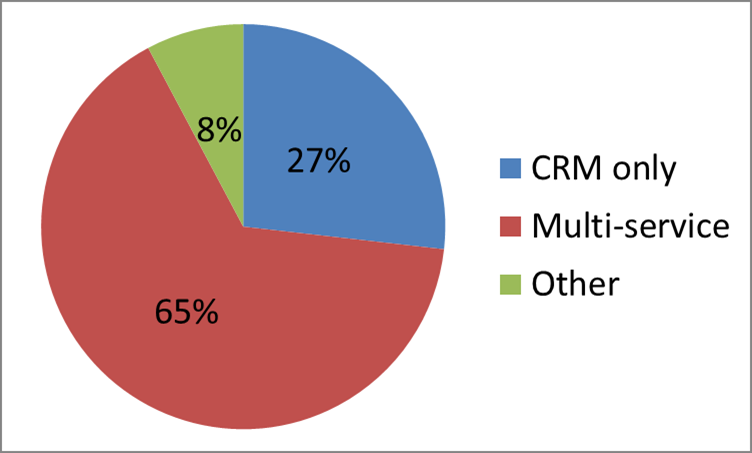
In 2011, multi-service firms posted more than twice the number of job ads for field technicians than did cultural-only firms. These employment data seem to support Dore’s observation that heritage-only firms are losing market share to multidisciplinary environmental and engineering companies.
There are limits to what can and should be inferred by these results. There are many small CRM firms that do not advertise for field technician positions as their projects are too small to require a full crew. Though it does say something that the majority of job adverts for lower level positions are being done by multi-service firms. The full data can be accessed here.
Shift in market share away from U.S. heritage-only firms
A pattern of data suggests that heritage-only compliance consulting firms are losing market share to larger multidisciplinary firms in the United States. Historically, there has been some ebb and flow of market share between heritage-only firms and multidisciplinary environmental and engineering companies. Now, however, there appears to be a more substantial, unidirectional shift and this trend has been underway prior to the U.S. economic recession of 2008.
The annual heritage compliance market in the U.S. has been estimated by many over the last decade to be in the range of $0.8-1 billion. While data to base this market estimate are poor, the fact that many authors (most notably Altschul and Patterson in 2010) have converged upon a fairly narrow range provides some measure of confidence. According to data from Environmental Business Journal, the overall environmental consulting and engineering sector of which heritage compliance is a part was valued at $27.6 billion in 2011. This, then, means that heritage compliance is 3.6 percent of the total environmental consulting sector in the U.S. Since 1991, there have only been two years (1996 and 2009) when the sector did not have positive growth. Since 2009, growth has been 2.2 percent in 2010 and 3.7 percent in 2011. Five percent growth is expected in 2012.
The American Cultural Resources Association (ACRA) has surveyed heritage firms periodically since the end of the recession. In March, 2010 44% those surveyed reported a decrease in business in the six months prior to the survey and 65% forecast that business would not grow in the six months following the survey. There was little change a year later when, in March 2011, 46% of firms reported a decrease in business over the previous six months and 61% forecast that business would not grow in the next six months. Yet, these surveys were done at a time when the industry grew by 5.9 percent, or about $53 million. What explains the opposing trends?
Most, but not all, firms that are members of ACRA are heritage-only companies. Additionally, there were some (29%) non-member firms surveyed but these firms likely fit the same heritage-only profile of member firms. So, the data indicate that while the market for cultural services was growing, the amount of work going to heritage-only firms was decreasing. If heritage-only firms were not seeing the increase, who was?
Data from the U.S. Bureau of the Census (Census) provides a clue. In 2009 and 2010, ACRA led an effort to request a North American Industry Classification System (NAICS) code for cultural resource compliance services. The request was denied and in public comment the Economic Classification Policy Committee (ECPC) of Census stated that “…ECPC considered the proposal and noted that cultural resource management, or cultural resource consulting services is a product provided by establishments in a variety of industries…Therefore, the ECPC does not recommend a new separate industry for cultural resource consulting. ” In short, Census did not establish a cultural resource industry in North America (U.S., Canada, and Mexico) in part because other industries were adequately providing cultural resource services. These other industries were not specified, but the primary “other” must be the Environmental Consulting Services industry (NAICS Code 541620): essentially the multi-disciplinary firms. Anecdotal data from conversations that I have had with a variety of business owners and CEOs over the last year seem to support this observation. Almost all told me that they believe that market share has been shifting from heritage-only companies to multidisciplinary environmental and engineering companies.
Business and industry data directly pertaining to the heritage industry is difficult to find. To identify and substantiate underlying industry and economic trends, one often has to stitch together disparate data and read between the lines. Such is the case with this analysis. That being said, it appears that while the market for heritage compliance services has been growing faster than the rate of economic growth (as measured by GDP) since the end of the recession, cultural-only firms are not seeing the benefit of this growth. Market share for heritage compliance services is shifting away from heritage-only companies to multi-disciplinary firms.
Boom times in Brazil
Brazil is the world’s seventh largest economy. It is also one of the fastest growing economies with a GDP growth rate of about 5 percent. Interesting news tidbits have been surfacing about contract archaeology in Brazil. Dr. Janet Levy (UNC Charlotte) recently told me that she learned at the last American Anthropological Association meeting that there is a demand for archaeology faculty in Brazil because archaeologists are selecting to work in the private sector instead of academia. I found this interesting and interviewed Dr. Eduardo Góes Neves, a Brazilian archaeologist, at the Society for American Archaeology’s conference in Panamá a few weeks ago. Indeed, he reported that private-sector archaeology is doing very well in Brazil driven by strong federal laws and the strong economy. There are mature companies across the country, some of which are quite large with multiple office locations. He also noted that there is currently a wave of acquisition of these firms taking place by companies based in Spain and Portugal.
Given this interesting business news from Brazil, I’m pleased to note that Dr. Renato Kipnis is joining Heritage Business Journal to cover the heritage industry in Brazil. Dr. Kipnis is a Director of Scientia Consultoria Científica Ltda. in São Paulo and will be keeping us up-to-date on business issues.
 Heritage Business Journal